What the EISA is
The EISA is a single, national, external assessment that tests whether a learner is competent in the occupation as a whole, after they’ve finished all the modules with their provider. Competent learners are awarded an occupational certificate by the QCTO.
Who runs it, and where
Only QCTO-accredited assessment centres may hold the EISA. They can include trade test centres, workplaces, providers, colleges and professional bodies. The Quality Partner for the qualification, often a SETA acting as Assessment Quality Partner or the National Artisan Moderation Body (NAMB) for trades, schedules and manages the EISA, including marking and moderation. The QCTO quality-assures the process and approves the results.
What a learner needs first
- To be enrolled with an accredited provider (or an assessment centre, for recognition of prior learning), and enrolled with the QCTO.
- To be competent in every module of the knowledge, practical and workplace components, or recognised through RPL.
- A statement of results from the provider, valid for two years, and their ID on the day.
- For qualifications at NQF levels 3 and 4, proof of Maths and English with the statement of results.
The provider must also have had a QCTO quality-assurance monitoring visit before its learners can be registered. More on PoEs and statements of results.
Registering learners
The QCTO publishes an EISA plan with the dates and the registration closing dates. About three months before the EISA, the provider sends its updated learner file, with the statements of results on the QCTO’s template, to the QCTO’s EISA readiness address. Late registrations aren’t accepted: learners who miss the closing date go to the next scheduled EISA. The EISA is conducted in English.
The QCTO samples internal assessments from the statements of results it receives, then sends the consolidated registrations to the Quality Partner that runs the EISA.
After the EISA
- Results: the Quality Partner should submit them within 21 working days of the EISA.
- Sign-off: the QCTO approves accurate results within 21 working days, and may refuse results that are submitted late.
- Certificates: the QCTO issues the occupational certificates to the Quality Partner within 21 working days.
Skills programmes and trades
Skills programmes have no EISA. The provider sets, conducts and moderates a final integrated supervised assessment (FISA), submits the results to the QCTO within 21 working days, and the QCTO quality-assures them before it certificates learners.
For trades, the learner takes a trade test at an accredited trade test centre. NAMB recommends certification, and the QCTO issues the trade certificate within 21 working days of receiving NAMB’s documents.
Where QCTO Boss fits
QCTO Boss shows which learners meet every requirement, flags the ones who don’t (a missing workplace sign-off, an ID copy), prepares the EISA readiness file and the statements of results, and records each learner’s registration and result.
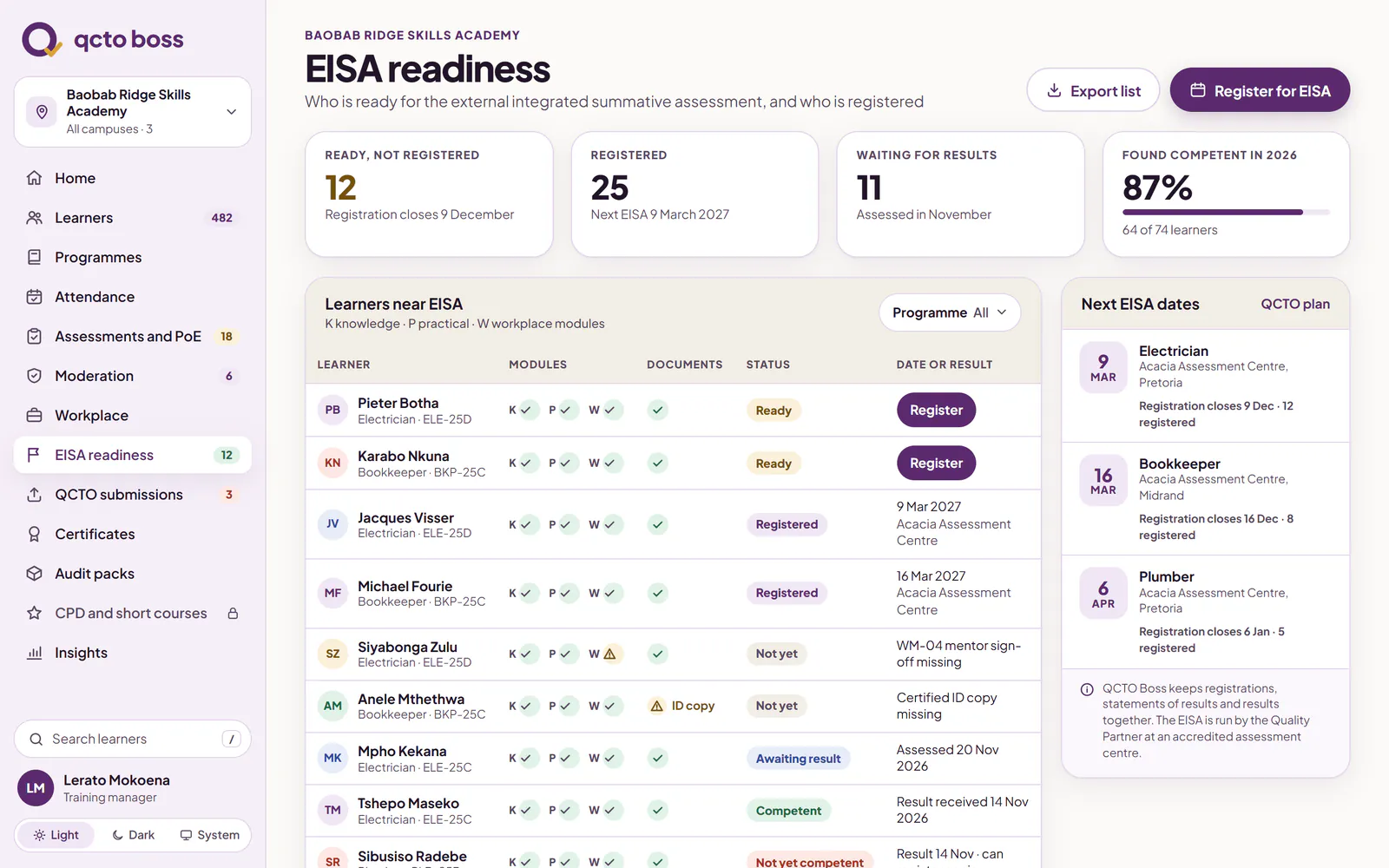
Design preview with made-up learners.
Questions
Who conducts the EISA?
The Quality Partner for the qualification, often a SETA acting as Assessment Quality Partner or NAMB for trades, manages the EISA at a QCTO-accredited assessment centre, including marking and moderation. The QCTO quality-assures the process and approves the results.
What does a learner need before the EISA?
To be enrolled with an accredited provider and with the QCTO, to be competent in every knowledge, practical and workplace module (or recognised through RPL), and to bring a statement of results and their ID. At NQF levels 3 and 4, proof of Maths and English goes with the statement of results.
Do skills programmes have an EISA?
No. A skills programme ends with a final integrated supervised assessment (FISA) that the provider sets, runs and moderates, and the QCTO quality-assures before it certificates learners.
How long after the EISA does the certificate come?
The QCTO’s guide allows 21 working days for each step: the Quality Partner submits the results, the QCTO approves them, and the QCTO issues the certificates to the Quality Partner.
- QCTO: Services for assessment centres
- QCTO: Publications, policies, guidelines and forms, including the Assessment Policy (September 2021, revised August 2022) and the Quality Assurance Policy (Monitoring and Evaluation), 9 September 2021
- QCTO: Key FAQs for skills development providers (version 6)
- QCTO: The Road to Success, the SDP’s guide to offering occupational qualifications, version 2, October 2024
- QCTO: Learner enrolment and EISA registration process (templates, data specifications, statement of results guideline)
- QCTO notice to accredited SDPs: learner enrolment and EISA registration process, 25 January 2023
- QCTO guideline and template for issuing a statement of results
- QCTO: For learners, including the certificates the QCTO issues
- QCTO Accreditation Policy, version 2.0, June 2022