What a PoE is
A PoE is the collection of a learner’s work and the assessment records that show they’re competent. On QCTO occupational qualifications, the provider runs the internal assessments for every knowledge, practical and workplace module and keeps the proof. The final, external check is the external integrated summative assessment (EISA).
What goes in it
- Knowledge modules (KM): tests, assignments and the marked scripts.
- Practical modules (PM): the tasks, observation checklists, photos, videos or products, and the assessor’s judgement against each criterion.
- Workplace modules (WM): the logbook or statement of workplace experience, signed off by the employer and by the provider.
- The assessment record: the date and outcome of every assessment and reassessment, the assessor’s feedback, and the signatures.
Who does what
- The facilitator delivers the learning and prepares learners for assessment.
- The assessor judges the evidence against the criteria: competent or not yet competent (NYC).
- The moderator checks a sample of assessments to make sure the judgements are fair and consistent.
- The employer or workplace mentor signs off the workplace evidence.
- The learner collects the evidence, signs for it and acts on feedback.
The QCTO’s Assessment Policy calls the people who assess and moderate “subject matter experts”, the role previously known as registered assessors and moderators. For practical assessments on trade qualifications, they must be qualified artisans registered with the National Artisan Moderation Body (NAMB). For legacy qualifications, SAQA’s records still ask for assessors registered with the relevant SETA.
Competent and not yet competent
The provider records a summative result for every module. A learner who is not yet competent gets feedback and another chance, and the record shows each reassessment with its date and outcome.
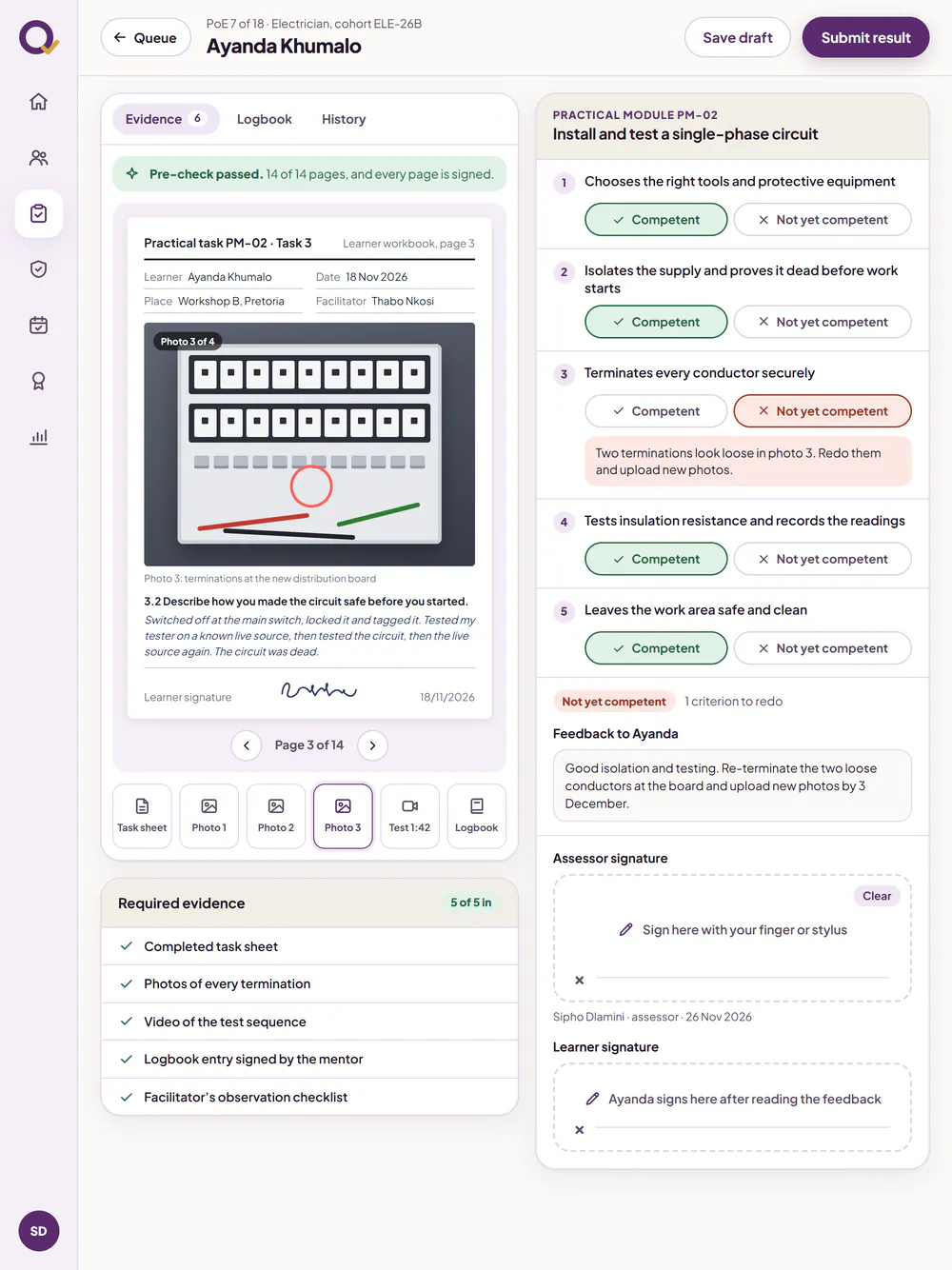
Marking a PoE in QCTO Boss. Design preview with made-up learners.
From PoE to statement of results
When a learner is competent in every module, the provider issues a statement of results. It is the learner’s admission document for the EISA and is valid for two years. The QCTO’s guideline says it must be titled “Statement of Results”, on the provider’s letterhead, and show the qualification as registered, its NQF level, the learner’s name and ID or date of birth, the assessment dates, the result for each module, a delegated signature and the Assessment Quality Partner’s name. It must also say: “This Statement of Results is not an Occupational Certificate.”
For qualifications at NQF levels 3 and 4, proof of Maths and English (a Grade 12 pass or equivalent, or a competent foundational learning statement of results) goes with it.
How long to keep it
Keep proof of all internal assessments until the learner is certified. After that it may be disposed of or stored digitally, as long as the summative results stay on record. Keep it securely, open only to the staff who need it: the QCTO points providers to POPIA.
Gaps that hold learners back
- A learner missing from the provider’s QCTO enrolment file: learners who weren’t enrolled with the QCTO can’t be registered for the EISA.
- Workplace evidence without the employer’s and the provider’s sign-off.
- Assessments with no dates, or reassessments that weren’t recorded.
- A statement of results without the required wording or, at NQF levels 3 and 4, without proof of Maths and English.
- Evidence thrown away before the learner is certified.
Legacy qualifications
For historically registered qualifications, the provider sets a final integrated supervised assessment, and the SETA or Quality Partner externally moderates the PoE. Once the QCTO approves the results, the SETA certificates the learner.
Questions
How long must a provider keep a PoE?
The QCTO’s Assessment Policy says proof of all internal assessments must be kept until the learner has been certified. After that it may be disposed of or stored digitally, as long as the summative results stay on record.
Who checks PoEs for legacy qualifications?
For historically registered qualifications, the provider sets a final integrated supervised assessment, and the SETA or Quality Partner externally moderates the portfolio of evidence. The SETA certificates the learner once the QCTO approves the results.
Does a learner get a certificate from the provider?
No. For QCTO qualifications and part qualifications, the provider issues a statement of results when the learner is competent in every module. The occupational certificate comes from the QCTO after the EISA.
- QCTO: Publications, policies, guidelines and forms, including the Assessment Policy (September 2021, revised August 2022) and the Quality Assurance Policy (Monitoring and Evaluation), 9 September 2021
- QCTO: The Road to Success, the SDP’s guide to offering occupational qualifications, version 2, October 2024
- QCTO guideline and template for issuing a statement of results
- QCTO: Learner enrolment and EISA registration process (templates, data specifications, statement of results guideline)
- QCTO Accreditation Policy, version 2.0, June 2022
- SAQA register: an example qualification record showing its last dates for enrolment and achievement