What accreditation is
A provider that wants to offer a qualification, part qualification or skills programme on the Occupational Qualifications Sub-Framework (OQSF) must hold QCTO accreditation before it starts offering, delivering or assessing it. The OQSF is the part of the National Qualifications Framework that the Quality Council for Trades and Occupations (QCTO) looks after.
Accreditation is granted for a specific physical address, for five years. Each extra site needs its own application, and moving to a new address means applying, and being visited, again.
The five steps
- Apply online. The QCTO’s page for skills development providers links a separate online form for each kind of application, such as occupational qualifications and part qualifications, skills programmes, and assessment centres. You don’t upload documents in the form itself.
- Send your documents. You get an acknowledgement and an email link to upload your supporting documents. The QCTO’s guide for providers says you then have 21 days to submit them.
- Desktop evaluation. The QCTO checks your legal standing on paper: company registration (CIPC) or proof of establishment, a current tax compliance status, CVs with certified IDs and qualifications for facilitators and assessors, proof of financial stability, a valid occupational health and safety audit report, proof of your premises, and a signed agreement with a workplace (the guide also accepts a letter of intent).
- Site visit. A verifier from the QCTO or one of its Quality Partners visits you, in person or on a recorded virtual call. Beforehand you return the site visit forms, including your implementation plan, learning material matrix and readiness evaluation tool. The facilitator must be there.
- Decision. The verifier’s report goes to the QCTO’s Accreditation Committee. If you succeed, you get an accreditation letter with a unique accreditation number for your address. After the visit you have 5 working days to send anything missing, and you can appeal within 7 working days.
The QCTO’s target is to finish within 90 working days of receiving all your documents.
What the site visit looks at
The QCTO’s guide for providers includes a consolidated checklist in three parts:
- Your institution: the documents from the desktop evaluation, plus a signed employment contract or service agreement for each facilitator.
- Your readiness to deliver: learning material for every module, qualified staff, inventories for the knowledge and practical parts, the NAMB equipment list for trades, classrooms and practical facilities, a workplace placement strategy and logbook, a career pathway, learner support, and a learner management information system (LMIS) that keeps records confidential under POPIA, with backups and access control.
- How you’re run: an organogram, and policies for governance and finance, human resources, teaching and learning, assessment, certification, appeals, health and safety, POPIA and refunds.
What it costs
In a notice dated 1 April 2025, the QCTO suspended its planned accreditation fees for occupational qualifications, part qualifications and skills programmes until further notice. Check the QCTO’s notices page for anything newer before you apply.
After you’re accredited
- Learner data. You send the QCTO each group of learners’ details on its Excel template within 21 working days of training starting, or within 5 days for skills programmes.
- Monitoring visits. Your learner enrolment data triggers QCTO monitoring: the QCTO’s guide says to expect at least one visit or evaluation a year, and one per intake. Check your readiness with our free checklist.
- Adding programmes. To extend your scope you use the same online application. For a skills programme linked to a qualification you’re already accredited for, the QCTO may extend your accreditation without a site visit.
- Renewing. Before your five years are up, you apply again through the same process.
Assessment centres and workplaces
Assessment centres, where the external integrated summative assessment (EISA) is held, are accredited separately. They apply through their own online form, and the relevant Assessment Quality Partner evaluates the application, visits and recommends it to the QCTO. Assessment centre accreditation lasts five years for the new occupational qualifications and three years for old trades.
The QCTO has delegated workplace approval, for the workplace part of a qualification, to the SETAs. You must make sure every learner is placed at one of the approved workplaces.
Where QCTO Boss fits
The QCTO deals with applicants directly, so QCTO Boss doesn’t apply for accreditation on your behalf, and nothing on this site is QCTO advice. What it does is keep the records that accreditation and monitoring look at: learners, attendance, assessments, workplace evidence and staff files, in a system built for confidentiality, with two-step sign-in, encryption, backups and an audit log.
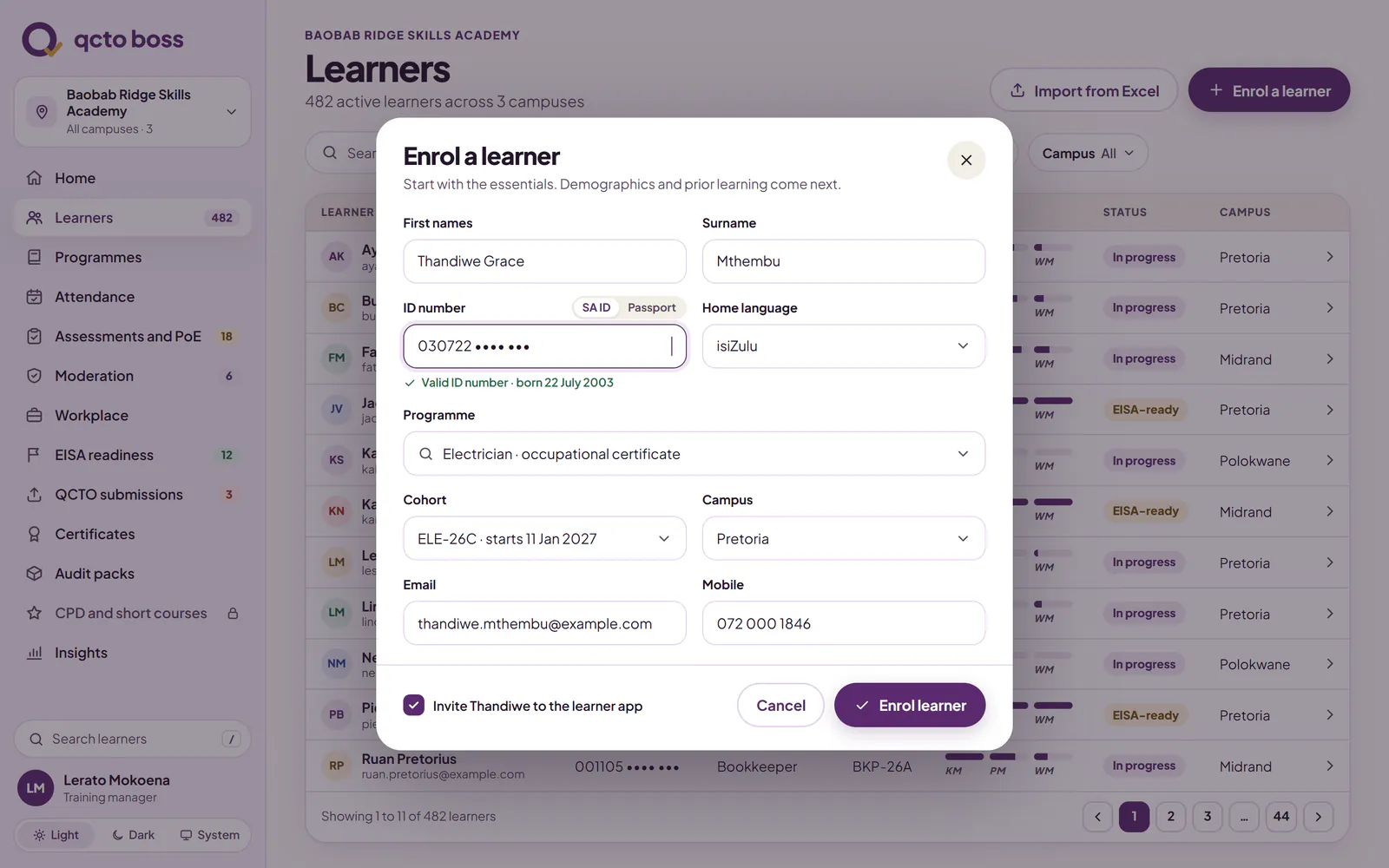
Design preview with made-up learners.
Questions
How long does QCTO accreditation take?
The QCTO’s target is to process an application within 90 working days of receiving all the documents.
How long is QCTO accreditation valid?
Five years from the date the QCTO grants it, unless it is withdrawn. Before it runs out, you apply again through the same online process.
Does QCTO accreditation cost anything?
In a notice dated 1 April 2025, the QCTO suspended its planned accreditation fees for occupational qualifications, part qualifications and skills programmes until further notice.
Can a consultant apply for us?
The QCTO deals with applicants directly. A consultant who helps must declare their role and may not take part in the site verification, and the contact details on the application must be the provider’s own.
- QCTO: Services for skills development providers (accreditation process and forms)
- QCTO Accreditation Policy, version 2.0, June 2022
- QCTO Criteria and Guidelines on Accreditation of SDPs and Assessment Centres (undated)
- QCTO: The Road to Success, the SDP’s guide to offering occupational qualifications, version 2, October 2024
- QCTO: Key FAQs for skills development providers (version 6)
- QCTO: Notices and circulars, including the suspension of accreditation fees (1 April 2025)
- QCTO: Services for assessment centres