What a monitoring visit looks at
The QCTO’s Quality Assurance Policy (Monitoring and Evaluation) of September 2021 sets out risk-based monitoring: self-evaluation, and announced or unannounced visits, in person or virtual, by the QCTO or its Quality Partners.
- Institutional monitoring checks your accreditation status and programmes, the qualifications of facilitators, assessors and moderators, tools and equipment, work experience and simulation, health and safety, any historical qualifications you offer and their last enrolment dates, learning support, learner record keeping (including your management information system), and readiness for remote or multi-modal learning.
- Programme implementation monitoring checks learner numbers and enrolments, the qualification, curriculum and assessment specification documents, RPL arrangements, your assessment strategy and dates, learner records, internal formative assessments, workplace evidence and learning support.
- Assessment readiness monitoring adds statements of results, how assessment tools are stored, invigilators and moderators, marking arrangements and invigilation plans.
How often, and what happens next
Your learner enrolment data triggers monitoring. The QCTO’s guide for providers says to expect at least one visit or evaluation a year, and one per intake, for qualifications and part qualifications. Before a visit you get a preparation checklist and may be asked for a self-evaluation. Critical findings can lead to follow-up visits, and a provider that doesn’t meet the requirements may be given time to fix them before it loses its accreditation.
Records to have on hand
- Learner files that match what you sent the QCTO.
- Attendance registers. The QCTO’s guide passes on providers’ advice that they’re critical for tracking absent learners.
- Proof of internal assessments for every learner not yet certified, and every summative result with its dates.
- Workplace evidence signed by the employer and by you, and a signed agreement between each learner and their employer.
- Staff CVs, certified IDs, qualifications and contracts.
- Your policies and a valid health and safety audit report.
The QCTO sets no fixed number of years for keeping most records; POPIA says personal information shouldn’t be kept longer than needed for its purpose.
Where QCTO Boss fits
QCTO Boss builds an audit pack for a monitoring visit in a few minutes from the records you already keep: learner lists, attendance, sample PoEs with sign-offs, moderation reports, staff files and policies, with any gaps listed first.
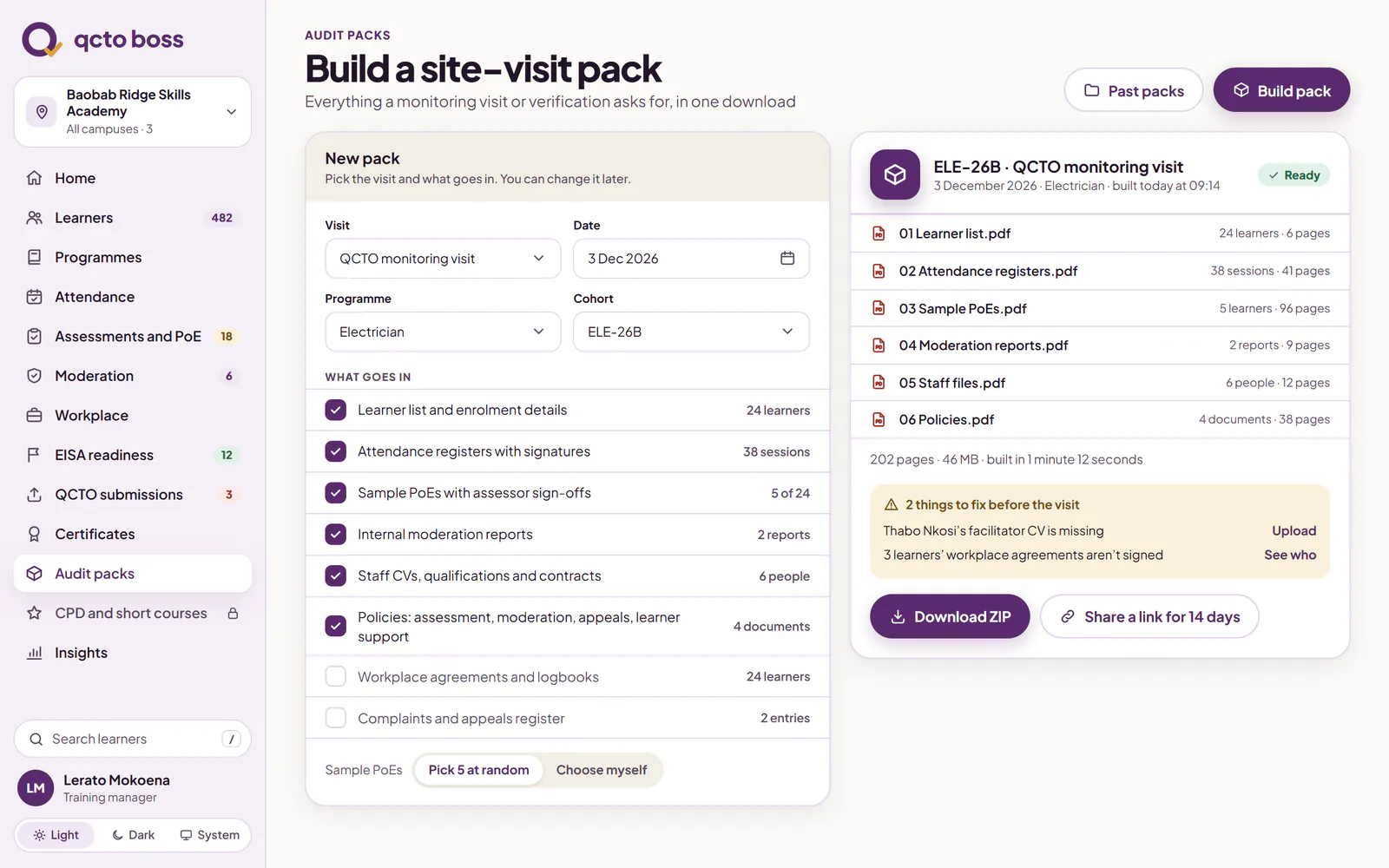
Design preview with made-up learners.
Questions
How often does the QCTO visit?
The QCTO’s guide says to expect at least one monitoring visit or evaluation a year and one per intake, triggered by the learner enrolment data you send. Visits can be announced or unannounced, in person or virtual.
Is this the QCTO’s own checklist?
No. It’s our summary of what the QCTO’s published monitoring policy and provider guide say it looks at. Before a visit the QCTO sends its own preparation checklist; use that one too.
- QCTO: Publications, policies, guidelines and forms, including the Assessment Policy (September 2021, revised August 2022) and the Quality Assurance Policy (Monitoring and Evaluation), 9 September 2021
- QCTO: The Road to Success, the SDP’s guide to offering occupational qualifications, version 2, October 2024
- QCTO: Quality assurance of occupational qualification implementation
- QCTO Accreditation Policy, version 2.0, June 2022
- Protection of Personal Information Act 4 of 2013 (Government Gazette 37067)